Online shopping has made it easier than ever to explore the latest women’s fashion trends, compare different styles, and shop for clothing from the comfort of home. From casual tops and stylish kurtis to dresses, jeans, and winter wear, you can find countless options with just a few clicks. However, one common challenge many shoppers face is choosing the right clothing size.
Unlike shopping in a physical store, online shopping does not always allow you to try on clothes before purchasing them. A dress may look perfect in a product photograph, but the fit might be different when it arrives. Differences in brand sizing, fabric, design, and garment measurements can make choosing the correct size confusing.
The good news is that you can reduce sizing mistakes by following a few simple steps. In this guide, we will explain how to choose the right clothing size when shopping online, how to measure your body accurately, how to understand size charts, and what to check before placing an order.
Whether you are shopping for everyday outfits, trendy dresses, ethnic wear, or winter clothing, these tips will help you make more confident purchasing decisions.
1. Understand Why Clothing Sizes Differ Between Brands
One of the first things to understand about online clothing shopping is that sizes are not always standardised across brands. A medium-sized top from one brand may fit differently from a medium-sized top from another.
This happens because clothing manufacturers may use different sizing systems, garment patterns, measurements, and fit preferences. Some brands design relaxed clothing, while others focus on slim or fitted silhouettes.
For example, a size M dress may feel comfortable in one brand but tighter around the shoulders or waist in another. Similarly, jeans with stretch fabric may fit differently from jeans made with rigid denim.
Before purchasing any item, avoid relying only on the size you usually wear. Instead, check the size chart provided on the product page and compare it with your measurements.
Tip: Always choose your size according to the individual product’s size chart rather than assuming that the same size will fit every garment.
2. Take Your Body Measurements Correctly
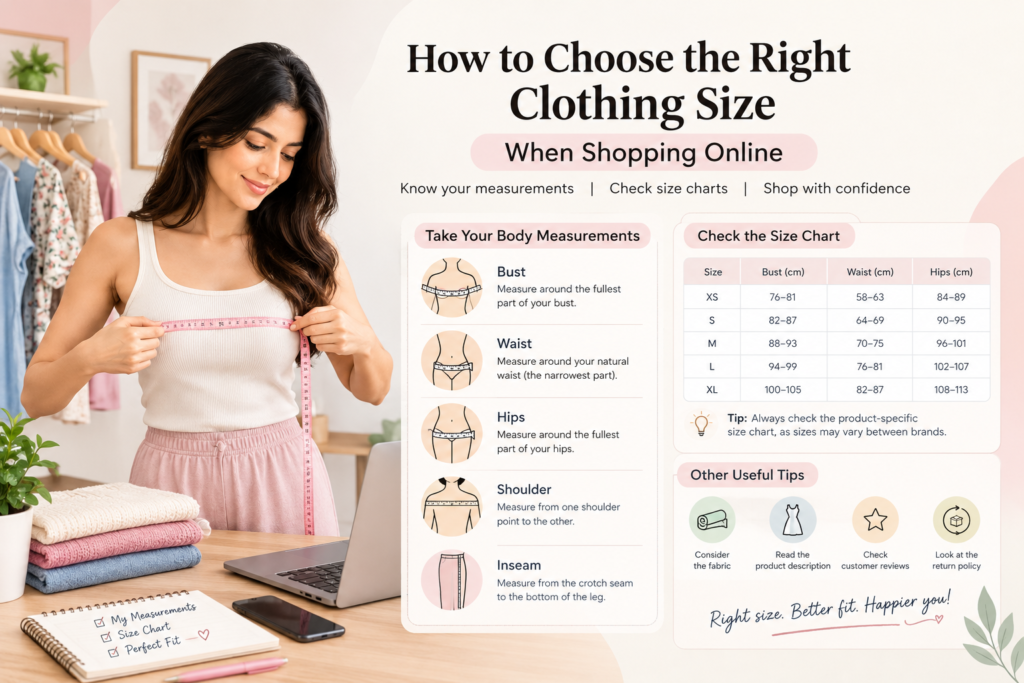
Taking accurate body measurements is one of the most useful ways to choose the right clothing size online. A flexible measuring tape can help you understand which size is likely to fit you best.
For more accurate results, measure yourself while wearing lightweight clothing. Keep the measuring tape comfortably against your body without pulling it too tightly or leaving it too loose.
Bust Measurement
Wrap the measuring tape around the fullest part of your bust. Keep the tape level across your back and avoid compressing the body.
Bust measurements are especially important when shopping for tops, blouses, dresses, kurtis, and jackets.
Waist Measurement
Measure around your natural waist, which is generally the narrower part of your torso between your ribs and hips.
Do not pull your stomach inward while measuring. Keep your body relaxed so that the measurement reflects your usual fit.
Hip Measurement
Stand with your feet together and measure around the fullest part of your hips and seat. Make sure the tape remains level all the way around.
Hip measurements are useful when purchasing trousers, jeans, skirts, fitted dresses, and other bottom wear.
Shoulder Measurement
Measure across the back from one shoulder point to the other, or ask someone to help you measure more accurately.
This measurement can be useful for structured shirts, blazers, jackets, and fitted tops.
Inseam Measurement
The inseam is the length from the crotch seam to the bottom of the leg. It is particularly useful when buying trousers, jeans, leggings, and other full-length bottoms.
Write down your measurements in centimetres or inches. Use the same unit as the size chart to avoid conversion mistakes.
3. Always Check the Clothing Size Chart
A size chart is one of the most important resources when shopping for clothing online. It helps you compare your body measurements with the brand’s recommended sizing.
Before adding an item to your cart, look for the size chart on the product page. Some stores provide a general size guide, while others offer separate charts for dresses, tops, trousers, jeans, and ethnic wear.
Follow these steps:
- Find the size chart for the specific product.
- Identify the measurements listed, such as bust, waist, hips, or garment length.
- Compare your measurements with the chart.
- Read any additional sizing instructions provided by the seller.
- Check whether the product has a slim, regular, relaxed, or oversized fit.
For example, if your measurements fall within the brand’s recommended range for size M, that size may be a suitable starting point. However, the garment’s cut, fabric, and fit description should also influence your decision.
If your measurements fall between two sizes, read the product guidance carefully. You may prefer the larger size for a relaxed fit or the smaller size for a closer fit, depending on the garment’s design and the brand’s recommendations.
4. Understand the Difference Between Body Measurements and Garment Measurements
Another important factor in choosing clothing sizes is understanding whether the measurements shown refer to your body or the finished garment.
Body measurements describe the dimensions of your body. A body measurement chart helps you identify the recommended size for your proportions.
Garment measurements describe the actual dimensions of the clothing item. These measurements may be larger than body measurements to provide room for movement and comfort.
For example, a loose-fitting dress may have a bust measurement larger than the wearer’s bust measurement. This additional room is often called ease.
A fitted garment usually has less room, while a relaxed or oversized garment generally has more.
Always read the measurement labels carefully. Comparing body measurements directly with finished garment measurements without accounting for ease can lead to choosing the wrong size.
5. Consider the Fabric Before Choosing a Size
Fabric plays a major role in how clothing fits and feels. Two garments with similar measurements can feel different because of their materials, stretch, thickness, and construction.
Cotton
Cotton clothing is popular for everyday wear because it is often breathable and comfortable. However, some cotton garments may shrink if they are not cared for according to their instructions.
Check the care label and product description, particularly if the item is made from a high percentage of cotton.
Stretch Fabrics
Clothing containing elastane or spandex may stretch and provide a closer fit. Stretch jeans, leggings, and fitted tops often have different sizing considerations from non-stretch garments.
Follow the brand’s fit guidance instead of automatically choosing a smaller size because the fabric stretches.
Linen
Linen is lightweight and breathable, making it suitable for warm weather. Linen garments often have a relaxed appearance, and some may wrinkle naturally during wear.
Check whether the item is designed for a loose fit or a more structured silhouette.
Denim
Denim can be rigid or stretchable. Rigid denim may feel less flexible, while stretch denim can offer greater movement.
When buying jeans online, check the waist, hip, rise, inseam, and stretch information.
Knitwear
Sweaters and knitted garments may have different levels of stretch depending on the knit construction and fibre composition. Review the garment’s measurements and intended fit before purchasing.
Understanding fabric characteristics helps you choose clothing that suits your comfort preferences and everyday needs.
6. Read the Product Description Carefully
Product descriptions often contain useful sizing information that shoppers overlook. Before ordering, read the description rather than relying only on product photographs.
Look for phrases such as:
- Slim fit: Designed to sit closer to the body.
- Regular fit: Usually offers a balanced fit without being especially tight or loose.
- Relaxed fit: Provides additional room for comfort.
- Oversized fit: Designed with a deliberately loose silhouette.
- Stretch fabric: Indicates that the fabric can stretch to some degree.
- Model measurements: May show the model’s height, measurements, and the size worn.
These details can help you understand how the garment is intended to fit.
However, remember that a model’s height and body proportions may differ from yours. Use model information as an additional reference, not as a replacement for the size chart.
7. Check Customer Reviews and Size Feedback
Customer reviews can provide useful information about how a garment fits in real life. When available, read reviews from shoppers who purchased the same product.
Pay attention to comments about:
- Whether the item fits as expected.
- Whether the fabric stretches.
- Whether the garment feels tight around the shoulders, waist, or hips.
- Whether the length is suitable.
- Whether the material feels lightweight or heavy.
- Whether the colour and appearance match the product photographs.
Some shoppers may mention that a product feels smaller or larger than expected. These comments can help you identify potential sizing concerns.
However, customer reviews are subjective. People have different body proportions, preferences, and expectations, so use reviews alongside the official measurements and product description.
8. Choose the Right Size for Different Types of Women’s Clothing
Different clothing categories require attention to different measurements.
Tops and Shirts
Check bust, shoulder, and garment length measurements. If the shirt is fitted, the bust and shoulder fit may be especially important. For oversized styles, review the intended silhouette.
Dresses and One-Piece Outfits
Consider bust, waist, hips, shoulder fit, and dress length. The importance of each measurement depends on whether the dress is fitted, straight-cut, A-line, or flowing.
Jeans and Trousers
Focus on waist, hip, rise, and inseam measurements. Also check whether the fabric has stretch and whether the trousers are designed to sit high, mid, or low on the waist.
Kurtis and Ethnic Wear
Check bust, shoulder, sleeve, and garment length measurements. For fitted kurtis, the bust and hip fit may be particularly important. For Anarkali and flared styles, the garment’s intended silhouette and length also matter.
Sweaters and Winter Wear
Consider shoulder width, bust, sleeve length, and layering requirements. If you intend to wear a sweater over another top, choose a fit that allows comfortable movement.
Jackets and Blazers
Check the shoulders, bust, sleeve length, and intended layering space. Structured garments may feel restrictive if the fit is too close.
Paying attention to category-specific measurements can make online shopping more predictable.
9. Check the Return and Exchange Policy
Even after careful measuring, a garment may not fit exactly as expected. That is why checking the return and exchange policy before purchasing is important.
Look for information about:
- The number of days allowed for returns or exchanges.
- Whether the item must be unused and have its original tags.
- Whether sale items are eligible for returns.
- Whether return shipping fees apply.
- Whether exchanges are available for a different size.
- Whether refunds are issued to the original payment method or as store credit.
Do not assume that every online store offers free returns or size exchanges. Policies differ between sellers and products.
Understanding the policy in advance can help you make a more informed decision and reduce uncertainty when shopping online.
10. Common Mistakes to Avoid When Shopping for Clothing Online
A few simple mistakes can increase the chances of ordering the wrong size.
Choosing your usual size without checking measurements: Your size may differ between brands and clothing styles.
Ignoring the size chart: The product’s individual measurements are often more useful than a generic size label.
Looking only at product photographs: Styling, camera angles, and model proportions can affect how a garment appears.
Ignoring fabric composition: Stretch, thickness, and construction influence the way clothing fits.
Confusing garment and body measurements: These measurements serve different purposes and should not automatically be treated as equal.
Overlooking garment length: Tops, dresses, trousers, and kurtis can look different depending on their length.
Failing to check the return policy: You should know your options if the garment does not fit as expected.
Avoiding these mistakes helps you shop more confidently and choose clothing that better matches your needs.
11. Create a Personal Measurement Guide
One practical way to simplify future online shopping is to keep a personal measurement guide.
Record your bust, waist, hips, shoulder width, and preferred trouser inseam. You can also note your preferred dress lengths and whether you usually enjoy fitted, regular, or relaxed clothing.
Keep the measurements dated and update them whenever necessary.
When shopping, compare this information with the measurements provided for each product. This saves time and helps you make more consistent choices.
Remember that your measurements do not automatically correspond to the same letter size across every brand. Always use the relevant product’s size chart.
12. Shop More Confidently with KlassyWe
Finding the right clothing size online becomes easier when you understand your measurements, compare size charts, and pay attention to fabric and fit descriptions.
Whether you are looking for everyday tops, stylish dresses, kurtis, jeans, or comfortable winter wear, taking a few extra minutes to review the product details can help you choose more suitable clothing.
At KlassyWe, you can explore women’s fashion and discover styles that complement your personal wardrobe. Before ordering any garment, review the available size information and product details to help you make an informed choice.
The goal is not simply to select a size label. It is to find clothing that feels comfortable, fits your preferences, and suits the way you want to dress.
Conclusion
Choosing the right clothing size when shopping online does not have to be difficult. Start by taking accurate body measurements, checking the product-specific size chart, understanding the fabric, and reading the product description carefully.
Customer reviews and return policies can provide additional guidance, while category-specific measurements help you choose tops, dresses, jeans, kurtis, and winter wear more effectively.
Most importantly, remember that clothing sizes vary between brands. Focus on measurements and comfort instead of relying only on labels such as S, M, or L.
With these practical tips, you can make better online shopping decisions and build a wardrobe that suits your style, comfort, and everyday needs.